
In this article
A tight sock line, and legs that feel heavy by evening
You already know the feeling: a tight sock line by evening, legs that feel heavy before you’ve even sat down for dinner. And if you’ve started wondering whether something could actually help, you’ve probably noticed how confident the claims sound — “supports circulation,” “reduces swelling,” each one sounding more specific than the last. The real question isn’t whether you should want relief. It’s how to tell which of those claims actually deserves your trust.
Why this category deserves extra scrutiny
Swelling and heavy legs are exactly the kind of symptom that makes a product feel like it’s working, whether or not it actually is — you can see the day-to-day difference, so it’s easy to hand the credit to whatever you just started taking. That doesn’t make every product in this category worthless. It does mean this specific category rewards reading claims carefully more than most, because “swelling went down” is exactly the kind of outcome that’s easy to attribute to a product even when the real cause was an ordinary day with less time on your feet.
Why it makes sense to look for something that helps
Wanting a product that helps here isn’t a lapse in judgment. Legs that feel heavy by the end of most days are a real, recurring discomfort, and looking for something that makes that better is a normal, reasonable response — the same instinct behind reaching for better shoes or a more comfortable chair. The goal here isn’t talking anyone out of that. It’s making sure whatever gets tried is actually likely to be one, which starts with knowing exactly what a circulation product’s claim is legally allowed to promise.
What “supports circulation” actually means, legally
A supplement is allowed to say it “supports” circulation, healthy blood flow, or similar — this kind of wording is what’s called a structure-function claim, a specific, regulated category, not a free pass to say anything. When a product makes one, that claim is legally required to come with a specific disclaimer: the statement hasn’t been evaluated by the FDA, and the product isn’t intended to diagnose, treat, cure, or prevent any disease. That disclaimer isn’t boilerplate to skim past — it means the FDA hasn’t reviewed or pre-approved the claim above it. The manufacturer, not the FDA, is the one who’s supposed to have real substantiation on hand that the claim is truthful and not misleading. A structure-function claim is worded carefully, on purpose, precisely because it doesn’t promise a specific, measurable result the way a drug claim would.
The regulatory gap that matters here specifically
Supplements don’t require FDA approval before they’re sold, and unless a product contains an ingredient newly introduced after October 15, 1994, the company isn’t even required to submit safety evidence to the FDA before it reaches shelves. The company carries the responsibility for the evidence and for the label being truthful. But nobody outside the company has to confirm that before you’re the one deciding whether to buy it. That’s true of every supplement category, not just this one, but it matters more here because circulation and swelling claims tend to sound especially specific and confident.
“Natural” still isn’t a safety claim
Worth repeating in this category specifically: natural doesn’t automatically mean safe. Some all-natural botanical ingredients have real, documented capacity for harm: liver injury from comfrey and kava are two well-known examples. A plant-derived circulation ingredient isn’t inherently gentler than a synthetic one; it’s just sourced differently, which isn’t the same claim as “safer.”
Red flags worth noticing, specifically
Here’s exactly what separates a claim you can trust from one that just sounds confident:
- A claim with no disclaimer in sight. If a product describes what it does for circulation or swelling without the required FDA disclaimer nearby, that’s a label that skipped a legal requirement, not a stronger claim.
- Language that implies a diagnosis or a cure. No supplement is positioned to diagnose or cure a circulatory condition — a product claiming otherwise is making a claim well beyond what “supports” legally allows.
- A single ingredient positioned as the whole answer. Circulation and swelling have multiple, genuinely different everyday and medical causes (see Why Your Legs and Ankles Swell More After 50), so a product promising one ingredient fixes all of it is oversimplifying the underlying problem, not solving it.
- No mention of the ordinary things that actually help. A product that never mentions movement, elevation, or reducing long stretches of sitting or standing is skipping the parts of this picture with the most direct support, in favor of the part it’s selling.
What a better-supported option actually looks like
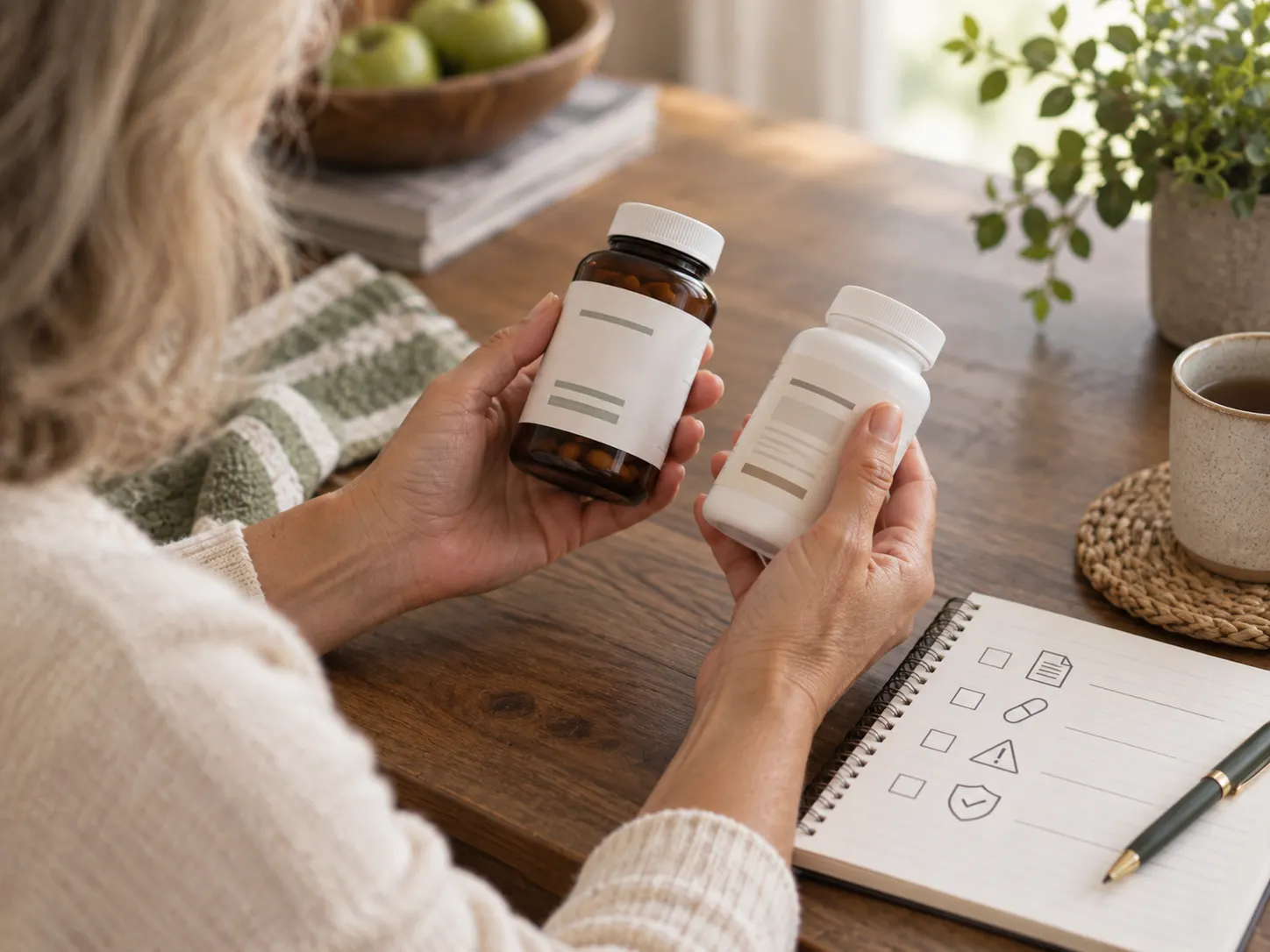
Each of those red flags has a reverse, and the reverse is just as specific:
- The required disclaimer is clearly present — adjacent to the claim, or clearly linked to it (an asterisk to a disclaimer on the same label is fine) — not missing, and not buried three screens down where nothing on the claim itself points to it.
- The language stays inside “supports.” It doesn’t imply diagnosis, treatment, or cure of a circulatory condition, no matter how the marketing around it is worded.
- It doesn’t position itself as the whole answer. Circulation and swelling have more than one real cause (see Why Your Legs and Ankles Swell More After 50), so a well-supported option tends to frame itself as one part of an approach that also includes the ordinary things that actually help — movement, elevation, and reducing long stretches of sitting or standing.
- Dosing and ingredients are disclosed specifically, not hidden behind a “proprietary blend.”
- Any research it cites actually matches what’s in the bottle. If a company points to a study, check whether that study used the same ingredient or extract/form, something close to the same dose, and an outcome that actually matches the claim being made — not just a study on the same broad category. A citation that doesn’t match the product isn’t evidence for it, even when it’s a real study.
None of that is a claim that any specific product works — it describes what responsible marketing and disclosure look like, which is the actual, checkable thing a label can tell you before you buy anything.
A few more things worth checking before you buy

The claim on the front of the label is only part of the picture. A few other checks matter just as much, and take less than a minute once you know to look for them:
- The company and the product are easy to pin down. A real manufacturer name, a real way to contact them, and one consistent formula, guarantee, and origin story across the label, the website, and any ad you saw it in — not a different account depending on where you encounter it.
- Amounts are disclosed, not just ingredients. Naming an ingredient tells you almost nothing without how much of it is actually in the product. A full amount for every ingredient is the real bar, not just the absence of a “proprietary blend.”
- Who shouldn’t take it is addressed somewhere. Even a genuinely well-supported ingredient can interact with blood thinners, blood pressure medication, or other prescriptions, or may not be appropriate during pregnancy or with certain conditions. A label that never mentions this hasn’t finished the job of letting you make an informed choice — worth a specific conversation with a pharmacist or doctor before starting anything new, not something to skip because the label sounds confident.
- A third-party testing claim is specific, not just a badge. “Third-party tested” without saying by whom, for what, or how to verify it is a claim, not proof. A named lab, a certificate you can actually look up, or a real accreditation is worth more than the phrase alone. Worth knowing either way: even a specific, verifiable third-party test is usually about identity, purity, or contaminants, not proof the product actually works.
- Return and guarantee terms are stated plainly, in one place. A guarantee is reasonable to look for, but it should read the same way everywhere it’s mentioned — not one length on the label, a different one in an ad, and a third one you only learn about when you try to use it.
None of this requires special expertise. It’s the same due diligence you’d already give any purchase that costs real money and goes into your body — this category doesn’t get a pass just because the claim sounds specific.
Turning this into a real decision
Put these checks together and they stop being a list to remember and become something to actually use: does the claim stay inside “supports,” with its disclaimer clearly placed rather than buried? Is the company and the formula easy to pin down, consistently, wherever you look? Are amounts disclosed rather than hidden in a blend? Does it address who shouldn’t take it, and does the guarantee hold up the same way everywhere it’s mentioned? Does it treat itself as one part of an approach rather than the whole fix?
A product that clears most of these checks isn’t automatically effective — nothing here claims a specific ingredient will work for you. But it’s the difference between a decision you can explain afterward and one you can only hope was right, and that’s a real, useful thing to walk away with regardless of what you end up trying.
What comes next
WFR doesn’t currently have a specific product in this category that has cleared our own bar closely enough to recommend by name — and we’d rather say that plainly than stretch a claim to fill the gap. When one does, it will need to hold up against every check above, not just the easy ones. Until then, apply the checklist above to anything you’re considering, alongside the same underlying framework in Reading Supplement Labels Like a Skeptic, After 50 — you’re already ahead of most of what’s on the shelf just by knowing what to check.
If swelling is new, sudden, one-sided, or comes with warmth, redness, or pain, that’s a same-day medical question, not a shopping decision — covered directly in Why Your Legs and Ankles Swell More After 50.
Was this helpful?
Thanks for letting us know.
Sources
What backs the claims in this piece — see our editorial standards for how we research and source every article.